
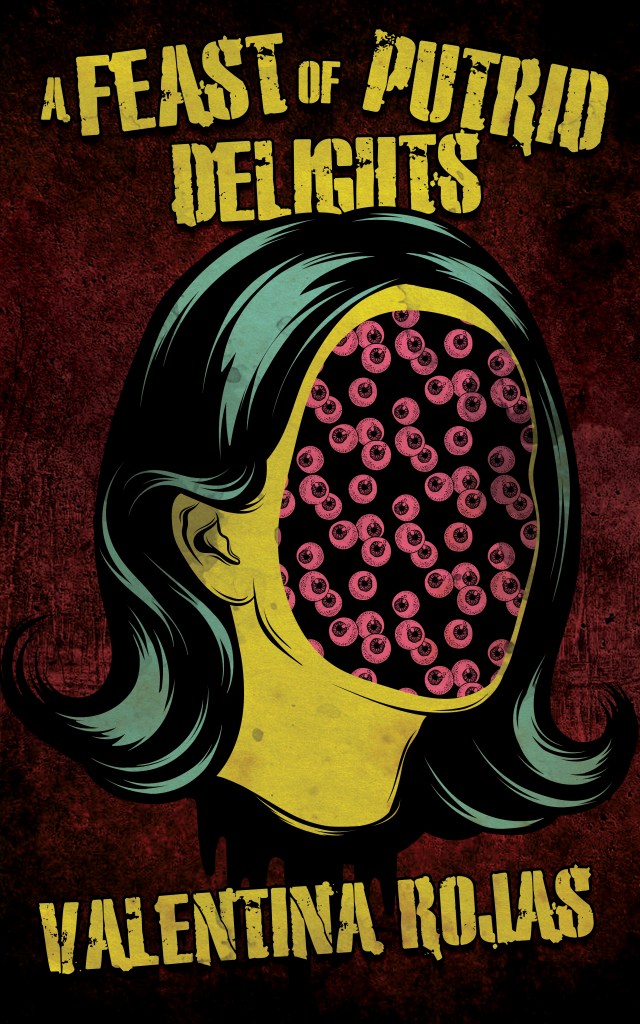
Valentina Rojas is not here to make you comfortable. If anything, A Feast of Putrid Delights reads like a dare: How much grotesquerie can you handle before your stomach turns? Rojas, an emerging voice in literary horror, takes the genre’s obsession with bodily decay, addiction, and psychological disintegration and slathers it all over the plate like a Michelin-starred splatter film.
While details on Rojas’ background are scarce, her work reads like someone who has either spent time in the high-pressure world of professional kitchens or at least done her research. The visceral language, the obsession with food as both salvation and corruption—this is a writer who understands the chaos of culinary culture and uses it as a vehicle for something much darker.
Our protagonist, Antonia, is a chef. A good one. But that doesn’t mean she’s got her life together. Instead, she’s slipping—mentally, physically, socially. Her appetite is gone, her relationships are fraying, and then there’s the whole seeing food as rotting, shimmering death sludge thing. (Minor inconvenience, really.)
A mix of disordered eating, drug use, and paranoia collide as Antonia navigates a high-end restaurant world that is every bit as toxic as her internal monologue. There’s an ex, Mika, who has moved on with a painfully put-together new woman, Hannah. There’s the enigmatic Booth, a dealer with a flair for the theatrical, supplying Antonia with a mysterious substance called Cloud. And then there’s the hunger. Not just the normal kind—the kind that drives her to make choices so stomach-churningly horrific, the phrase ‘eating disorder’ feels like a gross understatement. The book builds to a climax that is both inevitable and shocking, a full surrender to the grotesque urges that have been bubbling under the surface the entire time.
Rojas isn’t just writing horror—she’s writing about compulsion. About addiction. About what it means when your body turns against you, when every instinct you have leads you somewhere worse. A Feast of Putrid Delights is drenched in metaphor—food as power, food as punishment, food as a twisted form of self-destruction.

The horror in this novel doesn’t just come from the visceral descriptions of decay and consumption—it comes from the deeply personal nature of Antonia’s unraveling. Her inability to eat ‘normal’ food, her paranoia about what is real nourishment, the way her own mind rewires itself to see rot where others see sustenance—it’s an effective, stomach-clenching exploration of disordered eating through a horror lens.
Then there’s the social critique. Antonia’s disgust with the restaurant industry, her co-workers, her ex, the upper-class diners—it all feeds into a broader condemnation of capitalism’s gluttonous indulgence. The rich eat well, and they eat mindlessly, while those who serve them are consumed by the machine.
Rojas’ prose is lush, filthy, and feverish. There’s a rhythm to her sentences that pulls you in like a whispered secret before punching you in the gut with some fresh horror. It’s a style that swings between poetic and brutal, sometimes within the same sentence.
For example:
“A fleshy nameless hunger leads my feet into the room down the hall. What a smell. I can feel the heartbeat, the wonderful purity of that skin, of those organs. Take my hunger, take my tongue, and make me clean again.”
There’s a religious, almost ritualistic cadence to Antonia’s descent into her own particular brand of madness. The hunger is spiritual, the consumption an unholy sacrament.
The dialogue, too, is sharp and biting. The exchanges between Antonia and Mika, or Booth, or her coworkers are laced with exhaustion and venom, the kind of well-worn bitterness that comes from too many years in the trenches together. It’s effective, and it makes the horror feel all the more real.
The strengths of A Feast of Putrid Delights are undeniable—its atmosphere is suffocating, its protagonist is compelling in her self-destruction, and its horror is deeply, deeply gross in the best possible way. The body horror isn’t just there for shock—it’s integral to the story’s themes, making it all the more unsettling.
Honestly though, Antonia can be a bit exhausting—not because she’s badly written, but because her perspective is so unrelentingly bleak. This is a woman who is circling the drain from page one, and if you’re looking for any kind of redemption arc, look elsewhere. The novella is also so immersive in its feverish descent that at times, the narrative can feel too disjointed, too lost in Antonia’s unraveling. There are moments where the line between hallucination and reality blurs so much that it becomes frustrating rather than intriguing.
And then there’s the ending. Without spoiling too much, it goes all in on horror, on compulsion, on the feast. Some will find it the perfect culmination of everything Rojas has been building. Others will find it a bit too much, like eating one bite past the point of no return.
This is not a book for everyone. If you are squeamish, if you don’t want horror that lingers (not just in your mind, but in your gut), if you prefer your protagonists to be even vaguely aspirational—walk away. But if you’re the kind of horror fan who wants to be deeply disturbed, if you appreciate books that make your stomach churn and your brain work, A Feast of Putrid Delights is an absolute triumph of grotesque, hallucinatory horror.




Ghoulish Books
Published March 25, 2025


 The Blog Without a Face
Leave a comment