
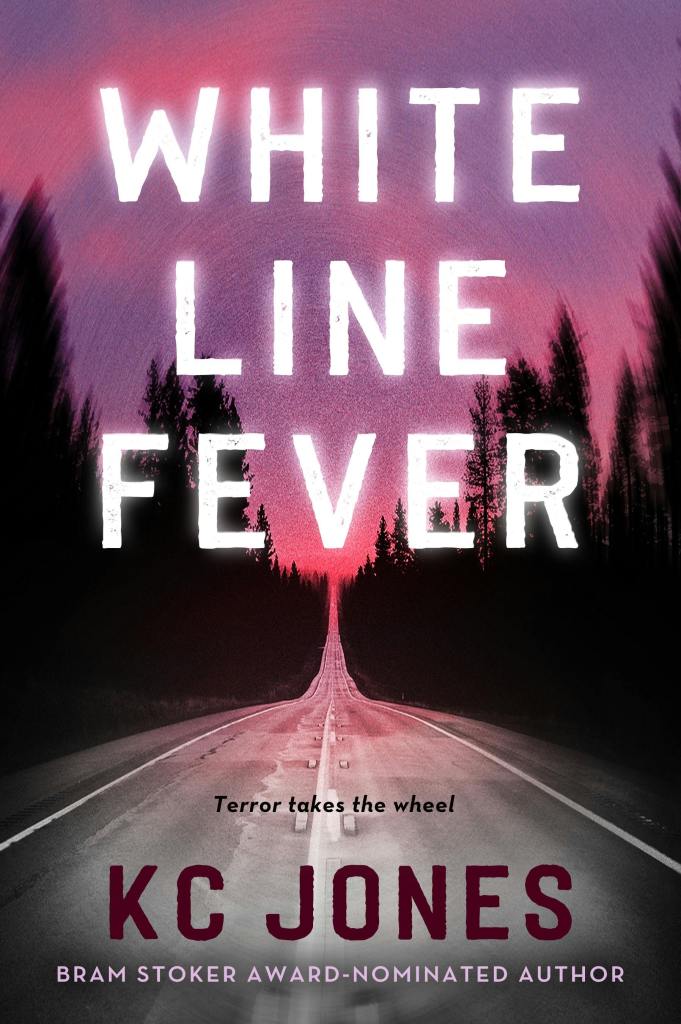
K.C. Jones‘ White Line Fever is a novel that takes a well-worn horror trope—“Hey, let’s take the shortcut through the obviously haunted road!”—and attempts to inject it with existential dread, past trauma, and a hefty dose of bad decision-making. It’s an interesting premise: four lifelong friends on a road trip to escape real-life troubles stumble onto the infamous County Road 951, a.k.a. The Devil’s Driveway, a stretch of highway with a body count higher than a slasher film’s third act. Unfortunately, while White Line Fever has the bones of a solid horror story, it often feels like it’s driving in circles, flashing its headlights at tension but never quite pulling up to the horror house.
Jones, who previously penned Black Tide, has a knack for atmospheric horror and a deep love for genre elements. With White Line Fever, he attempts a more psychological approach—blurring reality with hallucinations, forcing characters to confront their childhood demons, and making every wrong turn feel like a descent into madness. It’s an ambitious effort, though the execution wobbles between gripping and frustratingly sluggish.
Livia and her childhood best friends—Mo, Ash, and Becka—are on their way to a girls’ weekend at a resort, a much-needed reprieve from their personal disasters. Livia, in particular, is reeling from discovering her husband’s infidelity, so what better way to clear her mind than by speeding down a haunted highway? When they encounter road rage with an ominous tow truck (seriously, did no one learn from Duel?), they opt for a shortcut, guided by a GPS that must have been programmed by Satan himself.
Predictably, County Road 951 isn’t just some backroad inconvenience—it’s a supernatural meat grinder. Time warps, eerie hallucinations, and creeping dread ensue, with each woman being forced to relive past traumas in surreal, nightmarish ways. There’s a parallel timeline that takes us back to their youth, where they called themselves The Scoundrels, adding a coming-of-age flavor to the horror. But the big question lingers: will they make it out alive, or will they just become another set of names whispered in ghost-hunter YouTube videos?

Jones weaves heavy themes into the horror framework—particularly trauma, memory, and how our pasts shape our fears. The road itself acts as a metaphor for unresolved pain, serving up psychological torment.
The alternating timelines attempt to deepen the story, showing how childhood fears manifest in adulthood, but this structural choice is both a strength and a weakness. On one hand, it builds character depth; on the other, it frequently saps momentum from the present-day horror. White Line Fever tries to straddle psychological horror and supernatural spookiness, but it often lands in that middle ground where nothing feels fully realized. It’s scary, but not terrifying; introspective, but not deeply profound.
Jones is undeniably talented when it comes to creating an eerie atmosphere. The road itself is a brilliant setting—isolated, ever-changing, filled with whispered legends. The descriptive language is immersive, making you feel the claustrophobia of an unending, cursed highway. However, the pacing has all the grace of a drunk driver.
Many passages build up what feels like imminent horror, only for the tension to dissolve into nothing. It’s like being on a roller coaster that never quite drops. The dialogue, at times, feels genuine and lived-in, capturing the camaraderie of old friends, but there are moments where it dips into horror-movie cliché territory—characters making decisions so mind-numbingly bad you half-expect the Ghost of Common Sense to slap them upside the head.

Strengths
While the book suffers from pacing issues, there are undeniably strong elements:
- The Setting: A haunted stretch of road is always a fantastic horror backdrop, and Jones makes good use of its lore and creeping dread.
- The Psychological Angles: The way the road plays with perception and memory is genuinely unsettling at times.
- Character Development: While not always likable, the four leads have distinct personalities and realistic dynamics, which add emotional weight to their struggles.
Critiques
- Pacing Issues: The dual timelines, while interesting, often slow down the main narrative. The book builds tension repeatedly, only to let it fizzle out like a firework that didn’t quite ignite.
- Not Enough Scares: For a horror novel, White Line Fever is surprisingly light on true terror. It leans more into psychological horror, but even that could use more bite.
- The Ending: The conclusion is underwhelming—an abrupt finale that doesn’t quite match the buildup.
White Line Fever is a mixed bag. It has moments of brilliance, some haunting imagery, and well-crafted psychological horror, but it never fully capitalizes on its terrifying premise. Now that I think of it, it has some problems that parallel last year’s This Wretched Valley but with far superior character development. It’s a novel that creeps around the edges of greatness but never quite steps into the headlights.
If you’re a fan of slow-burn horror that leans more into atmosphere than outright scares, this might be your jam. But if you’re looking for a book that will make you sleep with the lights on, you might want to take the next exit.



Tor Nightfire
Published March 18, 2025

 The Blog Without a Face
Leave a comment