
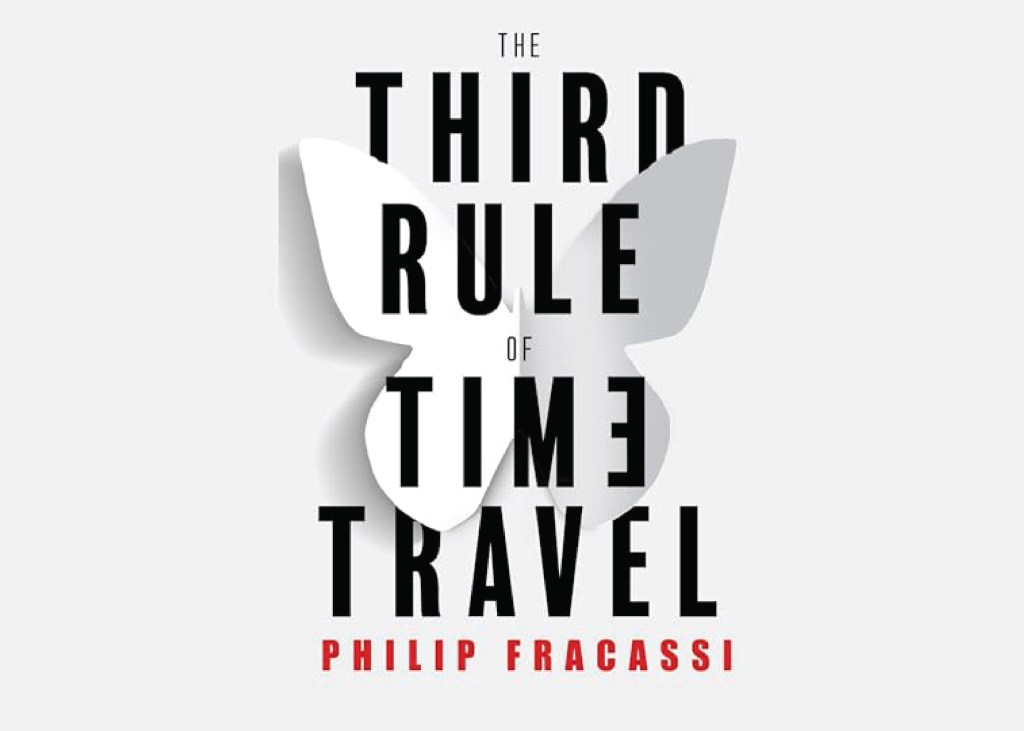

Philip Fracassi, known for his keen ability to weave terror into the mundane, takes a detour into the realm of science fiction with The Third Rule of Time Travel. With his horror roots evident in the creeping sense of unease that pervades the novel, Fracassi attempts to blend high-concept, hard science fiction with a deeply personal, spiritual human struggle. The result? A solid entry into time-travel literature, if not an entirely seamless one.
Fracassi has carved out a space for himself in modern horror, particularly with Boys in the Valley, a claustrophobic and brutal tale that married religious horror with psychological torment. His pivot to science fiction is intriguing, but the shift is not without its growing pains. However, while this novel could be perceived as a “shift” to science fiction, the reality is that The Third Rule of Time Travel has horrific moments, even hinting at elements of cosmic horror-allusions to a dark, vengeful universal intelligence. Fracassi’s signature ability to create an omnipresent sense of dread is still intact, lurking beneath the surface of its speculative framework. The novel carries a cinematic quality—perhaps owing to Fracassi’s background in screenwriting—but sometimes at the expense of deeper character introspection. While the tension and pacing are executed with skill, The Third Rule of Time Travel occasionally struggles under the weight of its ambitious premise.
Beth Darlow, a brilliant scientist, and her late husband, Colson, created a device capable of sending a person’s consciousness back in time—though with strict limitations. Travel is limited to the traveler’s own past, lasts only ninety seconds, and is meant to be purely observational. However, as Beth continues her experiments, grief-ridden and under pressure from her corporate benefactors, she begins to notice anomalies. Objects in her present appear altered, memories shift subtly, and her dead husband may not be as absent as she thought. As the boundaries of time unravel, so does Beth’s grip on reality, leading to an unsettling crescendo of consequences.

Fracassi’s novel thrives when it explores themes of grief, memory, and the fallibility of human perception. Beth’s descent into uncertainty mirrors the psychological unraveling often found in great horror protagonists. Her belief in rigid scientific principles clashes with the amorphous nature of time, symbolizing the human tendency to impose structure on an inherently unfathomable and unknown universe. The rules of time travel—the supposed safeguards—become an ironic testament to our misguided confidence in controlling the unknown. This is where Fracassi’s horror sensibilities shine: in the creeping dread that perhaps we are never truly the architects of our own narratives.
The novel also touches on the dangers of corporate greed and the ethical dilemmas of scientific advancement. Jim Langan, the billionaire funding Beth’s research, serves as an almost caricatured antagonist—an embodiment of unchecked power and capitalist ambition. While his presence reinforces the book’s warnings about technological exploitation, his one-dimensionality diminishes the impact of this critique.
Fracassi’s prose is clean, efficient, and highly readable. His background in screenwriting manifests in crisp dialogue and cinematic pacing, which keeps the story moving at an engaging clip. However, this same efficiency sometimes works against the novel, particularly in its character development. Beth, while compelling, occasionally reads as more of a collection of traits than a fully fleshed-out person. Her relationships, especially with her daughter and lab partner Tariq, feel under-explored, reducing some of their emotional weight.
One of the novel’s greatest strengths is its depiction of time travel in a relatively banal, almost procedural manner. Unlike the grand, high-stakes adventures of Michael Crichton or the speculative grandeur of H.G. Wells, Fracassi presents time travel in a restrained and methodical fashion. The presented methodology is believable. By limiting its function to brief, observational visits to the past, the novel avoids the usual paradox-laden dramatics and instead explores the personal and psychological implications of witnessing one’s own history. This measured approach lends the novel a grounded realism that makes the consequences of Beth’s travels feel all the more immediate and disconcerting.
Despite its flaws, The Third Rule of Time Travel succeeds in several key areas. Its central concept is engaging, and Fracassi does an admirable job of making the mechanics of time travel digestible without over-explaining. The novel also benefits from its pacing—short chapters and a propulsive plot make it a quick and compulsive read. Fans of Blake Crouch’s Dark Matter or Michael Crichton’s Timeline will find much to enjoy here.
Moreover, the creeping dread that suffuses the novel—though more restrained than in Fracassi’s horror works—adds a layer of intrigue that distinguishes it from more traditional sci-fi fare. The book’s best moments occur when the boundaries between past and present blur in unsettling ways, leaving both Beth and the reader questioning the very nature of reality.

Where the novel stumbles is in its supporting cast and its ultimate payoff. Tariq, Beth’s colleague, has potential as a counterbalance to her obsessive tendencies but remains underdeveloped. Langan, as previously mentioned, is more of a plot device than a fully realized antagonist. Other side characters, including a journalist investigating the project and a psychiatrist with ambiguous motives, never fully come into their own, leaving the narrative feeling somewhat hollow at times.
The climax, while kinetic and action-driven, ultimately leans on familiar genre tropes. The final act introduces a more abstract, mind-bending element that, while visually striking, lacks the emotional punch necessary to make it truly resonate. The resolution feels rushed, leaving lingering questions about the consequences of Beth’s choices and the fate of those around her.
The Third Rule of Time Travel is an intriguing departure for Philip Fracassi, blending speculative fiction with psychological horror. While it doesn’t quite reach the heights of his best horror works, it remains a solid, inspired entry into time-travel fiction. The novel’s strengths—its tension, concept, and accessibility—are occasionally undermined by shallow characterization and a conclusion that doesn’t fully capitalize on its eerie setup.
For horror fans curious about Fracassi’s range, this is a worthwhile read, though it may leave some craving the darker, more unsettling territory he has explored in the past. For sci-fi readers, the novel offers an engaging take on time travel. Ultimately, The Third Rule of Time Travel is a story that, much like its protagonist, reaches toward something profound—only to find itself caught in the disorienting currents of time.


Orbit Books
Published March 18, 2025





 The Blog Without a Face
Leave a comment