
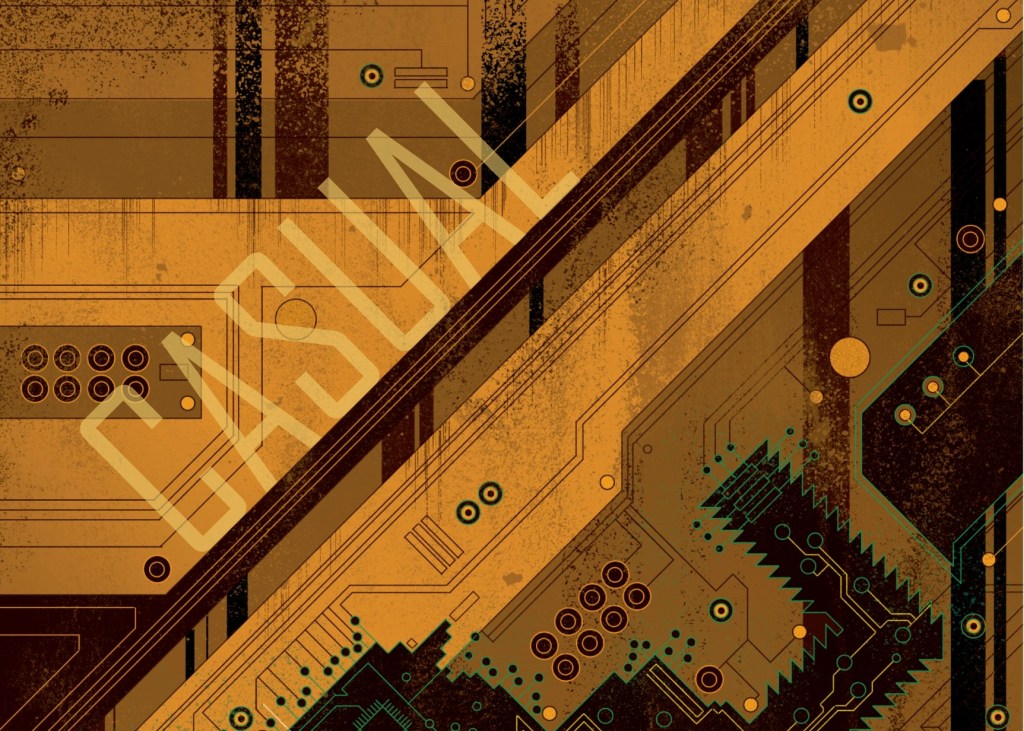

Koji A. Dae’s Casual is a cerebral and affecting meditation on technology, mental health, and personal autonomy set against the backdrop of a dystopian future. Through the experiences of Valya, a pregnant woman grappling with dependency on a neural implant designed to regulate anxiety, the novel deftly examines the intersection of human emotion and artificial intervention. At its heart, Casual is a compelling exploration of identity, agency, and the insidious consequences of a world increasingly shaped by digital augmentation.
One of the novel’s most incisive critiques is how mental health is managed in a world where neural implants are prescribed as routine treatments. The protagonist, Valya, is prescribed the Casual implant as a means of controlling her dexiety (a term blending depression and anxiety). While ostensibly a medical tool, the implant quickly becomes something more insidious—an instrument of social control. Casual questions whether technology, when used to regulate human emotions, enhances autonomy or erodes it.
Dae’s depiction of the implant’s function—granting controlled emotional regulation while subtly reinforcing dependency—resonates deeply with contemporary discussions about pharmaceutical intervention for mental health. Valya’s gradual realization that she may be dependent on the implant raises a fundamental ethical dilemma: is it truly healing, or merely a sophisticated form of sedation? This tension underscores a broader societal critique of how institutions often prioritize compliance over genuine well-being.
Valya’s struggles are not just internal; they are deeply embedded in the legal and social structures governing her life. As she nears childbirth, she is confronted with a draconian policy requiring primary caregivers to relinquish their Casual implants to retain custody of their children. This law, positioned as a safeguard against neglect, instead becomes a coercive mechanism that forces individuals into difficult choices—either conform or risk losing the very thing they seek to protect.

Through this plotline, Casual deftly explores the theme of bodily autonomy. The novel poses urgent questions about the limits of government control and the fine line between protection and oppression. How much choice does Valya really have? How much of her ‘consent’ is shaped by systemic coercion? The novel refuses easy answers, instead allowing these questions to linger in the reader’s mind.
One of the novel’s most fascinating aspects is how it interrogates the nature of memory and reality. Valya’s dependency on Casual is not merely about mood regulation—it also serves as an escape from past trauma. The game-like interface of the implant, which immerses her in a vividly rendered digital landscape, becomes both a refuge and a prison. Her struggle to separate real emotional growth from artificially induced stability is a poignant representation of the ways in which people use distractions—whether digital, chemical, or psychological—to cope with past pain.
Dae cleverly contrasts Valya’s neural dependence with the growing industry of ‘flogging’ (feeling logging), a technology that allows users to experience the sensations and emotions of others. This subplot offers a chilling extension of current trends in virtual reality and influencer culture, suggesting a world where experience itself becomes a commodity, curated and sold to the highest bidder. In this sense, Casual is also a critique of performative digital existence—how much of what we feel is truly our own, and how much is conditioned by external forces?
Valya is an intensely compelling protagonist. Her voice is both deeply personal and profoundly relatable, a testament to Dae’s ability to craft a character who feels real despite the futuristic setting. Her arc—from an emotionally dependent individual to a mother fiercely reclaiming control over her own mind—is meticulously developed.
Valya’s relationship with Skylar, her former partner, is equally fascinating. Skylar, a radical and charismatic figure, represents an alternative to the structured control of Casual. Yet, rather than positioning him as an unequivocal hero, Dae paints him with shades of contradiction—his ideals may be noble, but his methods are flawed. This complexity extends to the secondary characters, such as Orlov, Valya’s therapist, who is at once a well-intentioned advocate and a representative of an intrusive medical system.
The novel’s structure is also worth noting. The slow unraveling of Valya’s perception, interspersed with flashbacks, serves to highlight the precarious nature of her reality. Dae’s prose is lean yet evocative, balancing introspective depth with narrative propulsion. The novel’s pacing mirrors Valya’s psychological state, alternating between moments of intense clarity and dreamlike detachment.

Beyond its immediate narrative, Casual functions as a broader critique of contemporary society. The world Dae constructs—a post-collapse urban landscape governed by stringent technological oversight—mirrors real-world anxieties about surveillance, autonomy, and the commodification of experience. The parallels to current discussions on digital addiction, data privacy, and algorithmic control are striking.
Furthermore, the novel’s feminist undertones are particularly potent. The expectation that Valya must relinquish her autonomy for the sake of motherhood reflects persistent societal expectations surrounding gender and caregiving. Her fight is not just for personal freedom but for the right to define what kind of mother she wants to be, outside the rigid structures imposed upon her.
Casual is a fantastically constructed novel that operates on multiple levels—as a psychological thriller, a dystopian cautionary tale, and a deeply personal exploration of mental health. Dae’s ability to weave incisive social commentary into an intimate character study makes the novel a standout in speculative fiction.
Its themes of agency, memory, and control feel urgently relevant, challenging readers to consider the unseen ways in which technology shapes their lives. In the end, Casual is not just a story about a woman struggling against an oppressive system—it reflects our own world, urging us to question the forces that define our reality.
Casual is an essential read, particularly for those who appreciate speculative fiction that is both thought-provoking and emotionally resonant.


Tenebrous
Published February 10, 2025




 The Blog Without a Face
Leave a comment