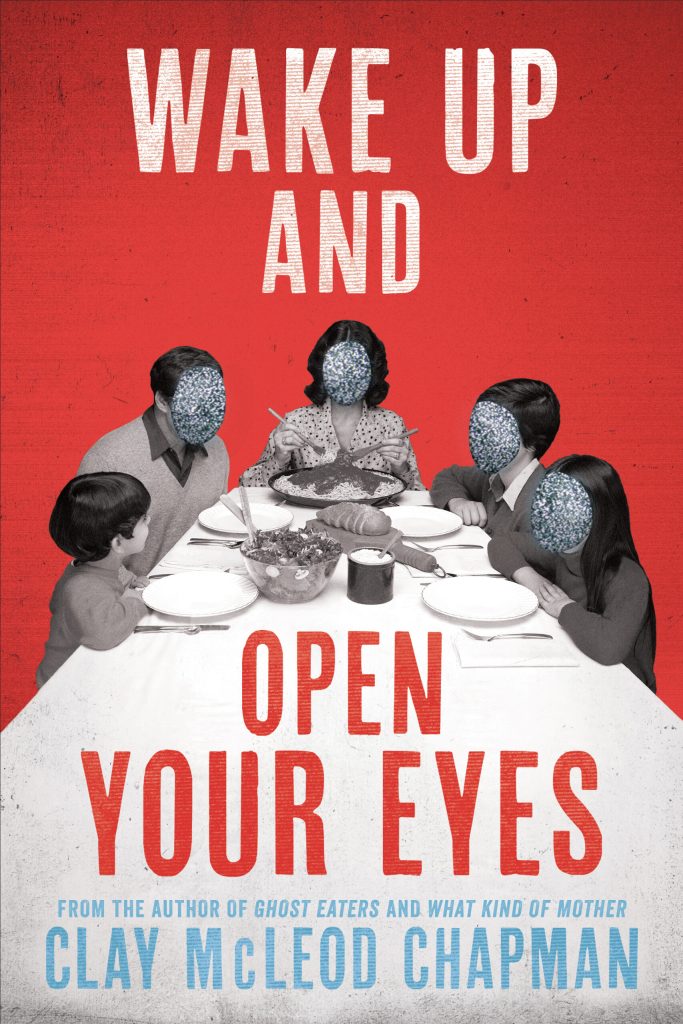
Clay McLeod Chapman’s Wake Up and Open Your Eyes is a goddamned primal scream, the literary equivalent of being locked in a panic room with a Fox News broadcast cranked to 11. From the first page, it grabs you by the scruff and shouts, “WAKE UP! OPEN YOUR EYES!” And if you’re not awake by the end of it, well, you’re probably the kind of person who’d watch “Just the Fax” and think, “Yeah, this seems reasonable.”
Chapman, one of horror’s modern masters, channels his fury into a scathing social commentary dressed up as a possession story. It’s like if The Exorcist and The Americans had a love child, then dropped it into the cesspool of modern American media culture. The result is terrifying, hilarious, and painfully relevant. Let’s break it down.
Noah Fairchild—a liberal Brooklynite—makes the mistake of checking on his parents in Richmond, Virginia, after they’ve gone radio silent. These aren’t just any parents; they’re Southern boomers mainlining conspiracy theories and guzzling the poison Kool-Aid of a far-right network called “Fax News” (I wonder what that could be). But when Noah finds them locked in a trance—rotting food in the fridge, TV blaring like it’s their life support machine—things take a turn for the horrifying. His parents attack him, not with words but with fists, teeth, and a batshit demonic rage with a disturbingly sexual twist.
Oh, but it’s not just Noah’s family. Across the country, families are imploding in waves of violent, cult-like fervor. And the glue holding it all together? Screens. Whether it’s TVs, social media, or wellness influencers, this plague of possession spreads through digital channels, turning ordinary people into rage-filled, bloodthirsty zealots. Noah’s only hope of survival is to team up with his young nephew Marcus and flee—but how do you outrun a monster when it lives in every screen around you?
At its core, this novel isn’t about zombies or demons. It’s about us—our addiction to media, our ideological divides, and the way unchecked technology worms its way into our brains like some malevolent parasite. Chapman doesn’t shy away from naming names either. “Just the Fax” is a thinly veiled stand-in for Fox News, and the book’s satire hits with the subtlety of a wrecking ball.
But don’t think Chapman lets the left off the hook. Noah, our protagonist, is the quintessential armchair liberal: full of righteous indignation but utterly ineffective when it counts. He’s just as complicit in this societal collapse as the possessed hordes, a point Chapman makes with gleeful venom, hilariously making his inner dialogue narrated by Anderson “the Coop” Copper in the second half of the book. By the end, you’re left wondering if anyone—liberal or conservative—deserves to survive this nightmare.
The symbolism here is as in-your-face as it gets. The screens are literal portals for demonic possession, a metaphor for how media hijacks our brains. But Chapman doesn’t stop there. He’s got wellness influencers peddling “purifying” juice cleanses that turn people into actual monsters. He’s got algorithm-fed radicalization pipelines that transform teenagers into incels. And then there’s the “Great Reawakening,” a conspiracy-laced apocalypse event that’s part QAnon fever dream, part The Purge on meth.
Chapman’s imagery is grotesque and visceral. There’s a family dinner scene that will make you reconsider ever sitting down to eat again. His descriptions of possessed bodies—twisted, twitching, vomiting black bile—are so vivid you want to shower. It’s body horror at its finest, and it’s impossible to look away.
If there’s one thing Chapman excels at, it’s creating tension. The pacing is relentless, each chapter ratcheting up the stakes until you’re practically chewing your own arm off in suspense. And the gore? Chef’s kiss. Chapman doesn’t flinch from the gruesome details, which makes the horror feel immediate and real.
The narrative structure is another win. The book is divided into three “phases,” each with its own unique tone and style. Phase One is a claustrophobic horror story centered on Noah’s family. Phase Two zooms out to explore how his brother’s suburban household succumbs to the madness. Phase Three—a road trip through an apocalyptic America—is a cacophony of found footage, social media snippets, and raw survival horror. It’s ambitious, and it works.
Chapman’s decision to blend horror tropes with sharp social commentary is very enjoyable. He doesn’t just aim for scares; he’s holding up a mirror to our current societal predicament, daring us to confront the monsters we’ve created. It’s a bold approach, and it pays off well. The sheer creativity on display here, from the chilling character arcs to the disturbing “set pieces,” is something you rarely find in genre fiction.
Here’s the thing: if you’re looking for nuanced, understated commentary, look elsewhere. Chapman’s sledgehammer approach won’t be everyone’s cup of tea. The repetition of the book’s titular mantra, “Wake up and open your eyes,” can feel heavy-handed. But honestly, when the world’s burning, maybe subtlety isn’t what we need. Character development is another sticking point. While Noah and Marcus are compelling, some of the side characters—like Noah’s brother Asher and his Instagram-obsessed wife—feel more like caricatures than fully fleshed-out people. Then again, when the message is this urgent, who has time for nuance?
That said, even the weaknesses feel deliberate, as if Chapman is leaning into the chaos to make a point. The over-the-top nature of the narrative mirrors the hysteria of the world it’s portraying. It’s a calculated risk, and while it might alienate some readers, it’s likely to resonate deeply with others.
In interviews, Chapman’s admitted that the book is deeply personal. He’s seen members of his own family radicalized by conservative media, a transformation he likens to possession. “It’s like my parents are possessed by demons,” he’s said. “So I made that literal.” Chapman also pulls from real-world horrors, like social media’s role in radicalizing young people. He’s unflinching in his critique of how we’ve let algorithms and echo chambers dictate our lives. And while the book’s satire leans heavily on conservative targets, Chapman doesn’t spare liberals either. As he’s put it: “If there’s a demonic apocalypse, we’re all fucked.”
The author’s ability to weave personal experiences into a broader cultural critique gives the book its emotional core. It’s clear that Chapman isn’t just writing to entertain; he’s writing to provoke, to unsettle, and to spark conversation. His unapologetic approach to storytelling is refreshing in a genre that often plays it safe. Wake Up and Open Your Eyes is a wake-up call, a slap in the face, and a gut punch all rolled into one. It’s a book that forces you to confront the ugliness of our media landscape and the ways we’ve all been complicit in its rise.
Is it perfect? No. But it doesn’t need to be. Its raw, chaotic energy is part of its charm. If you’re a fan of horror with something to say—or if you’ve ever looked at the state of the world and thought, “What the actual fuck?”—this book is for you. Just be prepared to smash a screen or two. Whether you come away from this book inspired to make a change or just thoroughly creeped out, one thing’s for sure: Wake Up and Open Your Eyes will leave a mark.
So yeah, fuck you, Clay McLeod Chapman. You’ve written a book that’ll haunt me. And also, thank you. Because maybe—just maybe—we all needed this.
Quirk Books
Published January 7, 2025
 The Blog Without a Face
Leave a comment