

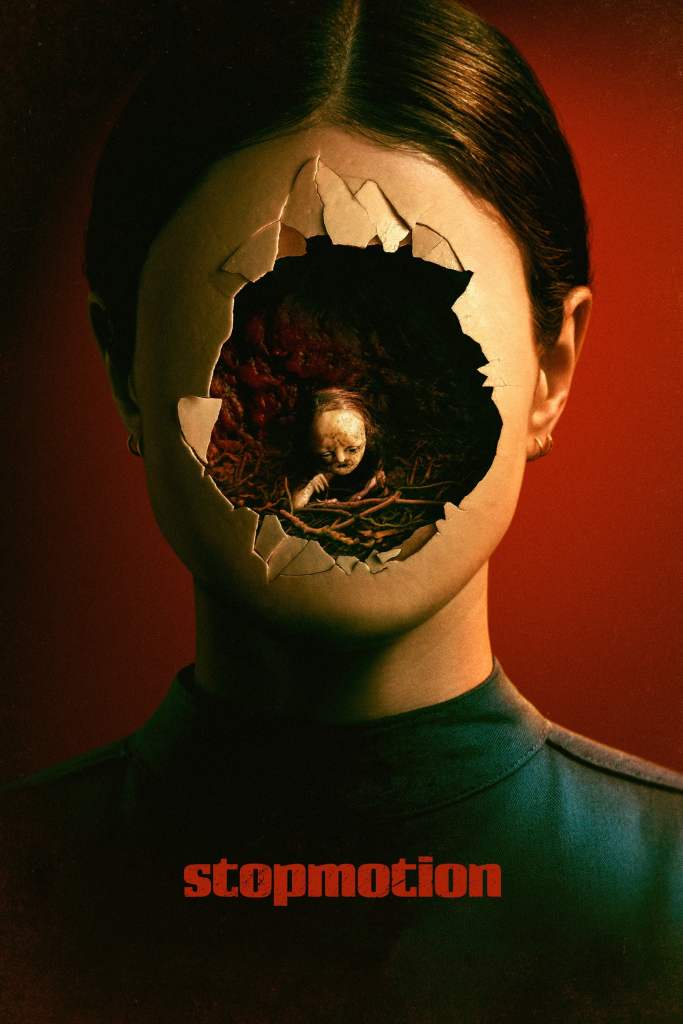
Stopmotion, Robert Morgan’s first foray into the realm of feature-length nightmares, serves as a stark reminder that perhaps not all of us are cut out for the painstaking world of stop-motion animation (Take a look at some of his excellent shorts below). Starring Aisling Franciosi, known for her work in films where comfort zones go to die, she delivers a performance that convinces us she’s never known a normal day in her life. As Ella Blake, she embodies the quintessential tortured artist who, under the thumb of her overbearing mother (played by Stella Gonet with a sternness that could give Gordon Ramsay a run for his money), embarks on a journey of self-discovery and mental unraveling that is as enticing as it is horrifying.
The film kicks off with the dynamic duo of Ella and her mother Suzanne in a symbiotic relationship that screams ‘therapist’s goldmine.’ Suzanne, a legend in the stop-motion world, now finds herself physically unable to continue her work due to what looks like rheumatoid arthritis – a plot twist that seems almost too convenient for someone so monstrously controlling. Enter Ella, her dutiful daughter, who’s less of a protégé and more of a glorified puppet manipulated by the grand puppeteer herself. The film wastes no time diving into the deep end of their twisted bond, setting up a tale that’s as much about creating art as it is about surviving a maternal relationship that could make Norman Bates nod sympathetically.
As fate would have it, Suzanne’s health takes a nosedive, and Ella finds herself freed from her maternal chains, only to shack up in an apartment that appears disconcertingly unlivable. It is here that she meets a peculiar little girl (Caoilinn Springall, delivering creepiness with the ease of a seasoned horror veteran), who inspires her to embark on a new project. One might argue that taking career advice from such an eerie child may not be the wisest move, but then again, this is a horror movie, and when has logic ever stopped anyone?
“Don’t be afraid. Great artists always put themselves into their work.”
Little Girl
What follows is an artistic endeavor that makes one think twice about the true cost of creativity. Morgan’s direction shines as he delves into the nitty-gritty of stop-motion animation – an art form that, as portrayed in the film, might just be the lovechild of patience and pure unadulterated nightmare fuel. The animation sequences are a sight to behold, mesmerizing in their detail and disturbing in their content.
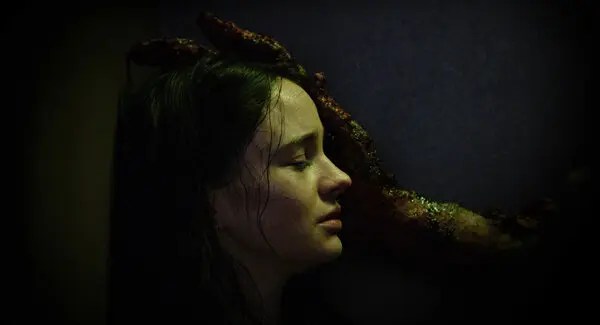
Cinematography by Léo Hinstin captures the claustrophobic essence of Ella’s world with such finesse. Meanwhile, the sound design by Ben Baird ensures that every creak, whisper, and squelch is felt in the pit of your stomach – a testament to the power of good audio to turn an already unsettling scene into a full-blown anxiety attack.
Yet, beneath the layers of psychological terror and avant-garde puppetry, Stopmotion treads a path well-worn by tales of madness and obsession. While the journey is familiar, the vehicle – a blend of live-action and grotesque animation – is anything but. Franciosi’s performance is the lynchpin of the film, bringing depth and nuance to a role that could easily have spiraled into caricature. She navigates Ella’s descent with a grace that makes you root for her, even as you question her life choices and taste in friends.
Stopmotion is a meticulously crafted ode to the horrors of creativity and maternal relationships that’s as unsettling as finding a doll’s eye in your quinoa salad. While it doesn’t reinvent the wheel – perhaps because the wheel is busy being used in one of Ella’s disturbing animations – it stands as a testament to Morgan’s unique vision and Franciosi’s formidable talent. It’s a film that will linger in your thoughts, like an unwelcome guest who overstays their welcome, making you ponder the true price of art, sanity, and whether it’s ever a good idea to take inspiration from eerie children with a penchant for storytelling.
If you haven’t checked out the movie, I recommend doing so now before we get into some more specific details you might not want spoiled. Spoilers ahead!


Director: Robert Morgan
Writer: Robert Morgan, Robin King
Released March 15, 2024

While some themes of Stopmotion are relatively straightforward, such as the often toxic relationship between an artist and their art, some of the symbolism and metaphors elude me.
For example, the little girl. She appears after the passing of Ella’s mother. Clearly she is a manifestation of Ella’s imagination, but what does she represent? She first appears at a point in Ella’s life when she is seeking a new direction for her work, separate from her mother’s influence. The girl provides Ella with a story that fuels her creativity. In this sense, the little girl could symbolize the spark of inspiration or the embodiment of Ella’s creative impulse.
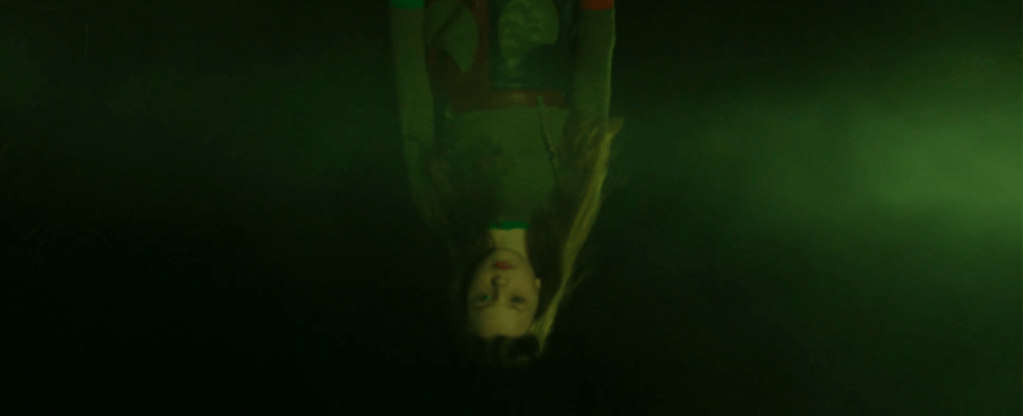
The child’s presence and connection to the dark story of the Ash Man might represent the innocence and vulnerability that exist within Ella. This could be an aspect of her psyche that she tries to protect but ultimately has to confront in the process of creating her film. Contradicting this, however, as the story progresses, the little girl drives Ella to make increasingly disturbing decisions, particularly in the creation of her film. Thus, it seems more likely the girl could symbolize the chaotic, uncontrolled aspect of creativity that pushes Ella beyond her moral and ethical boundaries.
While Ella’s childhood is not explicitly explored, based on the little interaction we see between her and her mother, I can’t help but assume Ella had a hard time growing up. Given the film’s psychological depth, the little girl might also represent unresolved traumas or fears from Ella’s own childhood. Her interaction with the girl could be a way of confronting these past issues.
I also wonder what the black egg-like object represents that the Ash Man feeds Ella. Eggs are often associated with new beginnings, rebirth, and the potential for new life. In the context of the film, this object could represent Ella’s transformation or rebirth through her art and the personal trials she endures. Alternatively, an egg is a fragile object, easily broken and vulnerable. This could symbolize Ella’s mental state and the precarious nature of her reality as she delves deeper into her project and loses grip on her sanity.

The act of feeding, especially with something as symbolically loaded as an egg, can represent care and sustenance. However, in the dark, twisted setting of Stopmotion, this act could also symbolize the corrupting influence of the Ash Man on Ella, feeding her obsession and leading her further into darkness. Finally, the egg could also symbolize the creative process itself — mysterious, full of potential, but also isolating and consuming. Ella’s consumption of the egg-like object might reflect her total immersion in her work to the point of self-destruction.
Finally, I’m still pondering the ending of the film, which I suspect that also be interpreted a number of ways. The ending, where Ella interacts with the Ash Man and the little girl while dealing with her own bodily mutilation, blurs the lines between reality and the animated world she’s created. This could symbolize the complete breakdown of Ella’s mental barriers, illustrating how her obsession with her art has consumed her reality.
In addition, the act of Ella using her own flesh (among those of others) to remake the figures could symbolize the extreme sacrifices artists sometimes feel they must make for their art — a literal interpretation of ‘putting oneself into one’s work’. Her ultimate destruction and the subsequent viewing of this scene as part of the ‘film’ within the film could represent the cyclical nature of creation and destruction in the artistic process.
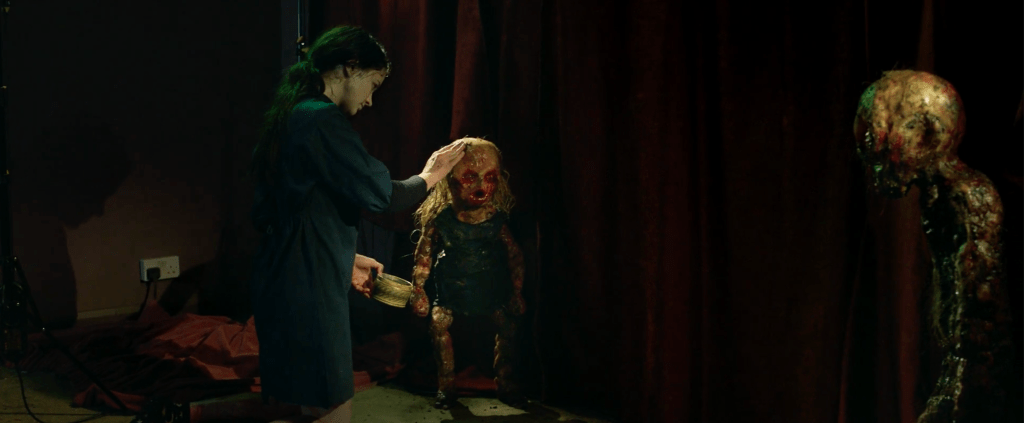
The ending also sees Ella confronting the physical manifestations of her fears and obsessions. The Ash Man could represent her fears, anxieties, or darker aspects of herself that she must confront to complete her artistic journey. Like many psychological horror films, Stopmotion leaves its ending open to interpretation. The surreal and disturbing nature of the finale invites viewers to consider their own interpretations of the film’s themes — the relationship between artist and artwork, the impact of trauma on creativity, and the boundary between reality and imagination.
The film’s complex symbolic and surreal elements encourages multiple interpretations, leaving the audience to ponder the real meaning behind Ella’s journey and its tragic end.
 The Blog Without a Face
Leave a comment